From Earth.
And back.
Flight 14 · an interactive film
Watch in the full browser window
The science behind the flight
One idea at a time in the film. More to explore here. Mission events come from SpaceX; the animated trajectory is modeled.
Orbit is falling without hitting the ground
A spacecraft in low Earth orbit travels roughly 7–8 kilometres every second. Gravity bends its path around Earth. Astronauts float because they and their spacecraft fall together; gravity at the International Space Station is still about 90% as strong as at the surface. NASA: free fall and gravity.
Engines work in a vacuum
A rocket pushes exhaust backward and gains forward momentum. It carries both fuel and oxidizer, so it needs no surrounding air to burn or push against. Once coasting in space, it does not need continuous thrust to keep moving. NASA: rocket thrust.
A terabit satellite is shared infrastructure
Starlink specifies V3 design capacities of 1 Tbps downlink and 160 Gbps uplink, with 2,048 beams in each direction. Twenty-six satellites imply 26 Tbps of aggregate design downlink capacity by simple multiplication. That is shared capacity across the fleet, not a speed promised to one customer or one location. Starlink: V3 specifications.
Yes, there are space lasers
Each V3 carries six laser links rated at 400 Gbps each. These connect satellites to one another; user terminals communicate by radio. A 400 Gbps link is about 7.1 million times a nominal 56 kbps dial-up link—not 10 billion times. This compares rated bit rates, not end-to-end internet performance. Starlink: laser network.
Electric propulsion trades a small push for efficient fuel use
Starlink documents argon Hall-effect thrusters for V2 Mini: electrically accelerated ions provide thrust for orbit raising, manoeuvres and disposal. A satellite coasts between manoeuvres; “the thrusters must run continuously” is too strong. This technology reference does not establish a two-to-four-month commissioning time for Flight 14’s payload. Starlink: 2024 technology report.
Lower orbits have a useful disadvantage: drag
The upper atmosphere is extremely thin, but it still slows satellites. At lower altitudes, failed spacecraft generally reenter sooner. The tradeoff is more drag to compensate for during operation. Starlink’s current altitude table lists V3 broadband at 330–360 km; those are operational constellation plans, not measured deployment altitudes for this film. Starlink: constellation altitudes.
Kessler syndrome is a collision cascade
A collision can produce fragments that cause more collisions. Over time, that can make some orbital regions much harder to use. It does not mean one launch seals off all access to space. Reliable disposal, collision avoidance and debris removal matter alongside altitude. ESA: the space debris environment.
The atmosphere does most of the braking
During entry, strong shock waves compress and heat the gas. Drag removes the spacecraft’s enormous orbital energy; thermal protection limits heat entering its structure. At the same mass, kinetic energy scales with speed squared: halving speed removes 75% of it. NASA: entry systems.
Low orbit helps latency, but distance is only part of the trip
Shorter radio paths reduce signal travel time. Actual latency also includes routing, ground infrastructure, congestion and the destination server. A satellite’s terabit capacity cannot establish an individual customer’s ping, subscriber count or direct connectivity to a car or robot. Starlink: service performance and limitations.
Solar panels are part of the propulsion and communications story
Starlink says V3 solar arrays generate about twice the power of V2 arrays. It manufactures the solar blanket as a continuous roll, cuts 19-metre segments, then joins four segments per array. More electrical power supports the satellite’s larger communications workload. Starlink: V3 power system.
A launch tower, a narrow atmosphere and an ocean waiting below. This cinematic study follows the arc of Starship's first orbital mission, with a reconstructed flight path and a camera you can take over.
The problem
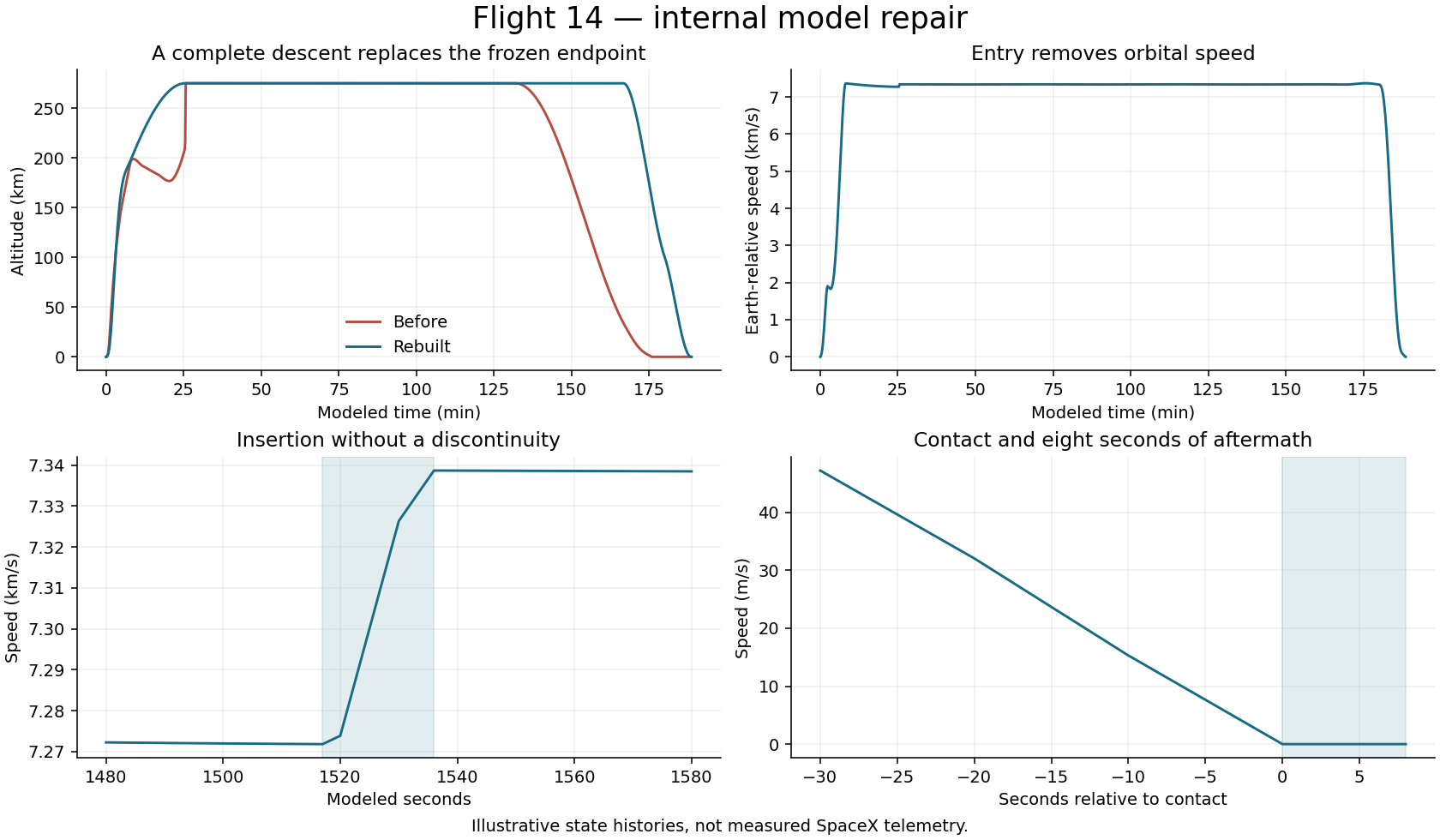
The first film broke the relationship between motion and meaning. Its vehicle was invisible, the flight path jumped at orbital insertion, and the ship reached the surface at orbital speed before standing still for more than twelve modeled minutes. Captions continued announcing a landing burn over an image that showed no landing.
Those failures needed a new flight model as well as a new picture. A camera cannot conceal an impossible trajectory and still tell a credible story.
The approach
The revised flight uses a continuous modeled state history. Position, speed, attitude, engine phases and event timing share one mission clock. A separate edit maps that long journey onto the original score without changing its playback speed.
The vehicle keeps its physical scale. Close tracking shots establish the stack beside the tower, reveal separation, follow entry and resolve the journey at the water. Terrain, reflections, atmosphere, exhaust and surface interaction supply the visual references that make scale readable.
Data and trajectory overlays are optional. Open View & sound to explore them, drag the picture to look around, or use Reset camera to return to the directed view. Chapters and the timeline move the music and image together.
The evidence
The mission is real; these images and state vectors are reconstructed. The SpaceX mission account describes suborbital ascent, a separate insertion burn, deployment of 26 Starlink V3 satellites and an early return to the northern Pacific. The visualization follows that event sequence.
Exact trajectory, return timing, camera views, weather and sea state are modeled. The published approximate timetable includes a longer planned mission, so it is not treated as a record of the shortened return. The optional Data panel displays Earth-relative model values, not measured flight telemetry.
The earlier model implied successive insertion-segment speeds of 18.32, 1.92 and 7.33 km/s, and roughly 7.58 km/s just above the surface. Those are diagnostics of the old animation, not facts about the real mission. Continuity and terminal-descent checks now accompany the recovered editable source.
The vehicle asset was supplied as SpaceX Starship Block 3 by Clarence365, attributed under CC BY 4.0. Earth day, night and cloud maps are from Solar System Scope / INOVE, under CC BY 4.0; they represent composite imagery, not mission-day weather. The original score is retained; its source and license metadata were absent from the inherited package. Credits and provenance.
The result
The result is an interactive cinematic reconstruction with a coherent modeled flight, deliberate shots and a visible ending. It is designed to be judged in motion: launch, separation, the return through the atmosphere and contact with the ocean.
This remains a visualization, not archival footage, a flight-certified simulator or a telemetry reconstruction. Numerical checks establish internal consistency; comparison with the primary mission account establishes which events the film can claim.